
Birth of the Beat and the 5 Forgotten Pleng Thai Sakon Songs That Invented Thai Pop (Pre-1960s)
Soundtracks of a Kingdom, Part 1: The Birth of Thai Sakon (Pre-1960s)
If you stepped onto a Bangkok street in 1925, the soundscape would feel entirely foreign to modern ears. You would hear the metallic ring of the ranat ek (Thai xylophone) drifting from temple grounds, the high-pitched hum of stringed saw u, and the rhythmic chanting of classical theater.
Fast forward just fifteen years, and everything changed. Gramophones were spinning in living rooms. Big-band trumpets, violins, and swinging jazz rhythms were suddenly echoing across social clubs. But the words coming out of those speakers were not in English, they were in rich, poetic Thai, wrapped around smooth vocal glides.
This hybrid beast was called Phleng Thai Sakon (literally "universal Thai music"). It was a cultural revolution masquerading as popular entertainment. Traditionalists hated it, calling it a cheap bastardization of sacred heritage. Young urbanites obsessed over it, buying up 78 rpm shellac records faster than factories could press them.
Without this chaotic era of trial and error, modern Thai pop, rock, and indie would simply not exist. Here are the 5 foundational songs that tore up the old rulebook and laid the groundwork for everything that came after.
1. "Bua Khao" (White Lotus)
Composed by Thanpuying M.L. Puangroi Apaiwong (1937)
If you need proof that Thai pop was born out of pure artistic rebellion, look no further than "Bua Khao". Before this song, Thai classical music relied on a complex pitch system that didn't align with Western musical scales. Mixing the two usually sounded jarring. Enter Mom Luang Puangroi, a young woman from an aristocratic background who had studied Western classical music at Trinity College in London.
She wrote "Bua Khao" for the soundtrack of the film Than Fai Kao (Old Flame). Using Western piano chords and sweeping string arrangements, she composed a gentle melody that somehow preserved the delicate, floating quality of traditional Thai singing.
Puangroi is widely recognized as Thailand's first female composer. In a time when women were expected to keep their artistic talents strictly within domestic walls, she was writing film scores that gripped the entire nation. Decades later, UNESCO recognized "Bua Khao" as a "Song of Asia". If you play the opening piano lines to any elderly Thai person today, watch their eyes light up as it remains the ultimate gold standard of early Thai composition.
2. "Suk Kanchana" (Let’s Be Happy)
Eua Sunthornsanan & The Suntaraporn Band (1939)
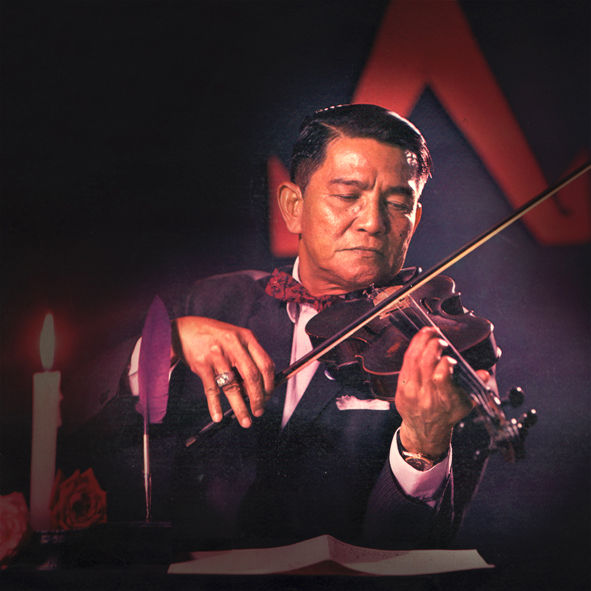
If Puangroi gave Thai Sakon its soul, Eua Sunthornsanan gave it a roaring engine. Eua was a classical violinist trained under Western music instructors hired by the Royal Fine Arts Department. But he had zero interest in staying in the concert hall.
In 1939, he formed the Suntaraporn Band under the government's official propaganda bureau. The state wanted music that sounded "modern" and "civilized" to show off to foreign diplomats. What they got was a cultural phenomenon.
"Suk Kanchana" was a high-energy track built on ballroom dance rhythms, specifically the Cha-Cha-Cha and Tango, which were sweeping through Western nightclubs at the time. Eua took those bouncy horn sections and layered them with upbeat lyrics encouraging a war-weary public to dance their troubles away.
Eua Sunthornsanan was a notorious workaholic who composed over 2,000 songs in his lifetime. The Suntaraporn Band became so famous that they essentially functioned as a national institution, playing live radio broadcasts every single week. "Suk Kanchana" didn't just get people onto the dance floor to cut the rug a bit, it taught a generation of Thai listeners how to tap their feet to a Western beat.
We would also be remiss if we didn't mention that he's the composer of the timeless music that is the soundtrack to the Thai new year, Songkran.
3. "Nam Ta Lao Wieng" (Tears of a Lao Girl)
Suraphol Sombatcharoen (1954)
By the early 1950s, Thai Sakon was starting to split into two camps: classy, uptown ballroom music for Bangkok elites, and raw, countryside storytelling for everyone else. Suraphol Sombatcharoen single-handedly bridged that gap and created a monster hit in the process.
Suraphol was a former Royal Thai Air Force nurse who kept getting locked in the military brig because he’d sneak out at night to sing in local clubs. When he recorded "Nam Ta Lao Wieng" in 1954, he brought a totally new vocal delivery to the table. Instead of the pristine, formal choir singing favored by city bands, Suraphol sang with a heavy, nasal twang, subtle micro-tonal bends, and an unashamed countryside accent.
This track marked the early years that birthed Luk Thung (Thai country music). Suraphol took the orchestration of Thai Sakon and used it to tell a heartbreaking story about a rural migrant girl struggling to adjust to life in the big city. The song resonated so deeply with rural laborers flocking to Bangkok for work that it turned Suraphol into the "King of Luk Thung," paving the way for his legendary, and tragically short, career.
4. "Yen Lom Wow" (The Chula & Nai Song Kites)
Chantana Kitiyapan & The Royal Navy Band (Late 1940s)
One of the coolest quirks of the early Thai Sakon era was how songwriters used Western jazz to construct elaborate metaphors for traditional Thai life. "Chula Riang Song" is the absolute peak of this technique.
The song uses the syncopated, playful rhythms of swing jazz to describe a traditional Thai kite fight, a popular pastime where a large male kite (Chula) tries to snare a smaller, agile female kite (Pakpao) mid-air. The vocalists trade rapid-fire, witty verses back and forth, matching the bouncing brass lines note for note.
The track demonstrated that Thai Sakon wasn't just copying Western big bands in exact replica, it was playing with them. The song showed off a wicked sense of humor and proved that complex, rapid Thai wordplay could fit into a Western jazz structure without losing its punch. It became a staple for school sports days, river boat races, and temple fairs for decades.
5. "Phleng Samakkhi Chumnum" (Auld Lang Syne - Thai Version) – Various Artists / Government Commission (1940s)
You cannot talk about the pre-1960s era without touching on how music was used as a tool for nation-building. During the 1940s, Prime Minister Plaek Phibunsongkhram launched a series of cultural mandates aimed at modernizing Thailand. The government literally ordered musicians to write songs that promoted national unity, hard work, and modern social etiquette.
"Phleng Samak Samakkhi" as its also known, took the familiar melody of the Scottish folk song "Auld Lang Syne" and re-wrote the lyrics entirely in Thai. Instead of reminiscing about old friends over a drink, the Thai lyrics implored citizens to stand together, love their neighbors, and build a strong, unified nation.
While it sounds like heavy-handed propaganda on paper, the song slipped effortlessly into public life. It was taught in every primary school, played at the end of scout meetings, and broadcast on state radio every evening. It transformed an imported Western melody into something deeply emotional and universally recognized across every province in Thailand.
It's easy to look back at these recordings with their warm vinyl crackle and mono mixing and write them off as simple nostalgia. But that would be a mistake. The musicians of the pre-1960s era were walking a tightrope. They had no playbook, no digital autotune, and a critical elite waiting to tear them down for ruining classical traditions. By forcing Western brass and keys to speak the Thai language, they built the entire foundation of modern Thai pop culture from scratch.


Comments